Typical guitar amps are ‘3-sided boxes’ in which one of the two largest surfaces is metal but the other one wood or particle-board, or whatever the cabinet material is, rarely metal. Guitar amplifiers having all metal chassis (including metal knobs) seem to be rather rare.
When GAGA was released its full-metal-chassis design was attacked by a few online assertions of ‘inherently unsafe’ all-metal design.
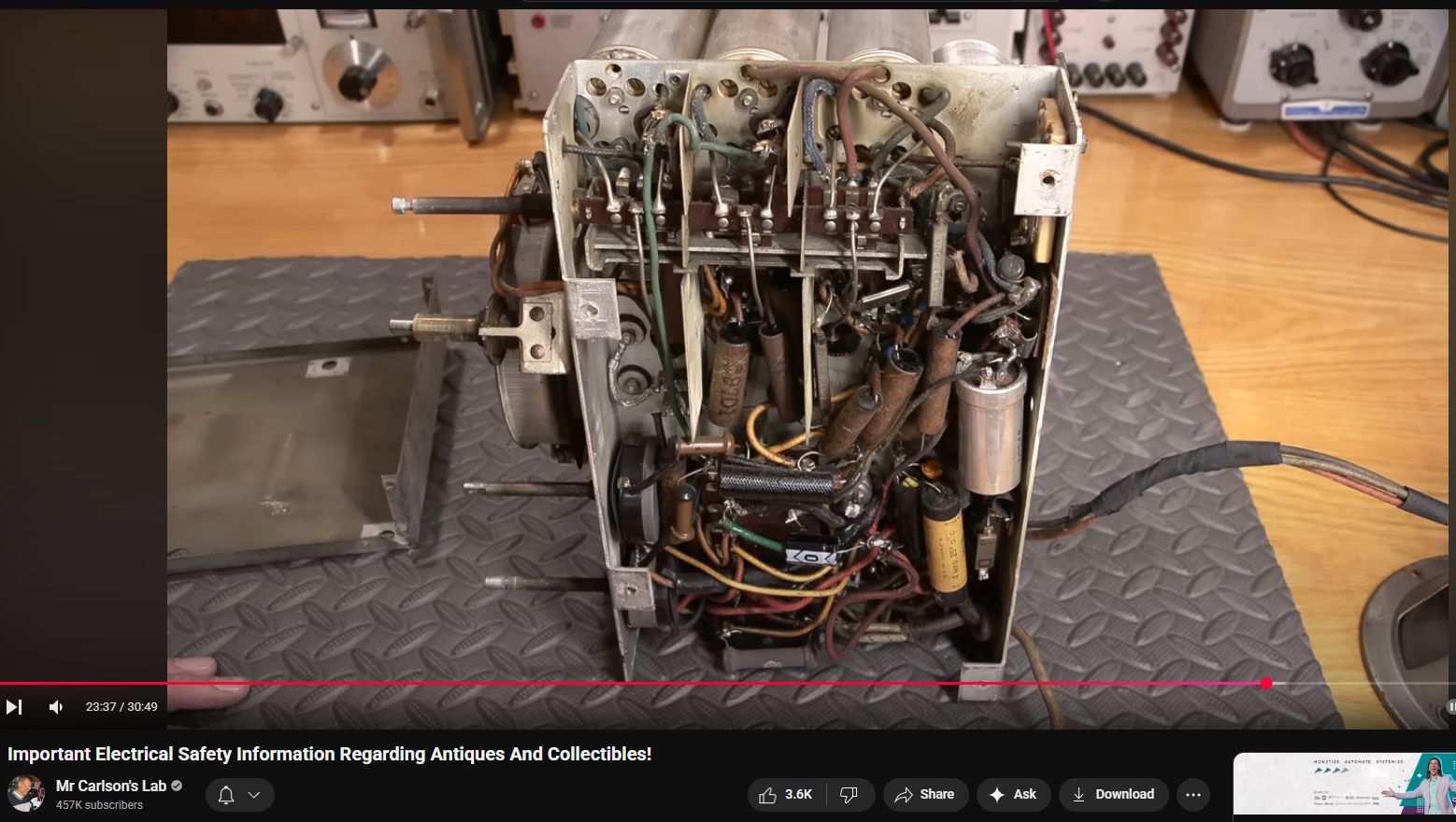
This recent video warning about shock hazard in a largely-wooden chassis (with wooden knobs) lent a chuckle.
GAGA is built to meet or exceed UL specifications, and it is CE rated for emissions and safety.
Evaluation — unpacking that sentence piece by piece:
1. UL Specifications
UL (Underwriters Laboratories) is an independent U.S. safety certification and testing body.
- When a device is “built to meet or exceed UL specifications”, it means the manufacturer claims the design and construction follow UL’s published safety standards (e.g., UL 60950-1, UL 62368-1 for audio/video/IT equipment).
- These cover fire safety, shock hazards, leakage currents, insulation, grounding, wire sizing, over-temperature performance, and enclosure strength.
- UL certification involves destructive and endurance tests: high-pot (dielectric withstand) tests at thousands of volts, flame resistance of plastics, fusing and circuit protection validation, abnormal operation testing, etc.
- Strictly speaking, “built to UL spec” is weaker than “UL Listed”. Only a UL mark on the product confirms UL actually tested it. Without that mark, it could mean the company followed the rules but didn’t pay for certification.
2. CE Marking
CE (Conformité Européenne) is a European Union regulatory mark:
- Emissions → Compliance with EMC Directive (2014/30/EU), meaning the product won’t interfere with radios, Wi-Fi, or other electronics (conducted/radiated emissions, susceptibility testing).
- Safety → Compliance with Low Voltage Directive (2014/35/EU) and often harmonized EN standards (similar to UL standards).
- CE marking is legally required for sale in the EU. Unlike UL, it’s usually a self-declaration by the manufacturer (sometimes with third-party testing).
- Tests include conducted emissions (150 kHz – 30 MHz), radiated emissions (30 MHz – 1 GHz+), immunity to ESD, fast transients, surges, and safety checks for creepage/clearance, grounding, and temperature rise.
3. DIY Measurements (What You Can Check Yourself)
Partial checks not requiring laboratory measurement gear —
- Ground continuity: Measure resistance from chassis to ground pin of power cord (<0.1Ω is good).
- Leakage current: With an isolation transformer and meter, check chassis leakage at 120 VAC (UL limits ~0.5 mA for consumer gear).
- Hi-pot testing: Apply high voltage between live parts and chassis with a hipot tester (careful — dangerous).
- Temperature rise: Use a thermocouple or IR camera to monitor hot spots after hours of operation. UL standards limit touchable surfaces.
- EMI checks: A spectrum analyzer + LISN can give a crude sense of compliance with FCC/CE emission limits.
- Fuse check: Ensure primary fusing exists and is rated properly.
4. Safety of All-Metal Chassis with 120 VAC Equipment
- Metal enclosures must always be bonded to protective earth (PE/ground).
- UL/CE standards require a low-resistance earth path so that if a live wire touches the chassis, the breaker or fuse trips immediately.
- If ground is missing or faulty, the entire case can sit at 120 V relative to earth — lethal if touched.
- A double-insulated (Class II) product avoids this by using reinforced insulation and plastic enclosures, but metal-chassis gear almost always must be grounded.
- Touch currents (leakage through EMI filters or insulation capacitance) are strictly limited — for Class I gear, typically <0.5 mA under UL/CE.
5. Takeaway
That sentence about thee device signals:
- UL spec compliance: Designed to U.S. safety benchmarks, but check if it’s UL Listed (actual certification) or just “built to spec.”
- CE rated: Manufacturer asserts it passes EU electrical safety and EMC requirements.
- For DIY verification: you can spot-check grounding, leakage, and thermal safety, but true compliance requires lab-grade EMC and hi-pot testing.
- Metal chassis safety depends entirely on solid earthing. A device can be beautifully built, but without a proper ground it can still be dangerous.